In 2026, the global disposable vape industry is reaching a true turning point.
For nearly five years, disposable devices have been the main engine of growth in the e-cigarette market. Their success was easy to understand: they were simple to use, inexpensive to produce, highly profitable, and required no learning curve for consumers.
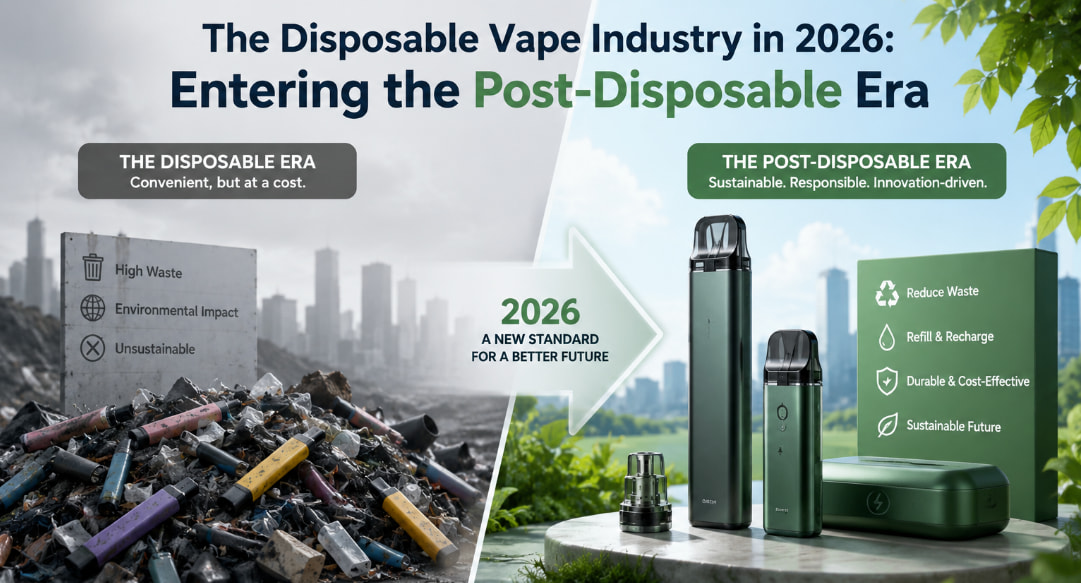
That formula fueled an unprecedented expansion.
Factories in Shenzhen scaled at remarkable speed. Distributors rushed to secure shelf space across North America, Europe, and the Middle East. Flavor launches accelerated, and puff counts climbed from 3,000 to 15,000, then to 30,000, 50,000, and beyond.
For a while, the industry operated under one assumption: disposable vapes would continue growing indefinitely.
That assumption no longer holds.
The End of the Wild Growth Era
The post-disposable era does not mean disposable vapes are disappearing.
It means the era of unchecked expansion is coming to an end.
Disposable products will remain an important part of the nicotine market, but they are entering a more regulated, more competitive, and more mature phase.
The companies that succeed in the next cycle will need more than manufacturing scale. They will need compliance expertise, strong branding, and the ability to operate globally.
Why Governments Are Tightening Controls on Disposable Vapes
For years, many industry observers believed youth access was the primary concern of regulators.
That is still a major issue, but the regulatory conversation has expanded significantly.
Governments are increasingly treating disposable vapes as a category of uncontrolled nicotine products.
This distinction matters because it changes how these products are regulated.
Instead of being viewed as ordinary consumer goods, disposable vapes are being treated more like tightly supervised nicotine delivery systems. This shift will reshape the market over the next several years.
Environmental Pressure Is Becoming a Major Regulatory Driver
One of the most important challenges facing disposable vapes is environmental sustainability.
Each device combines a lithium battery, plastic housing, coil, and nicotine e-liquid. In most countries, dedicated recycling systems remain limited.
As a result, millions of devices are discarded as electronic waste every day.
Regulators in the United Kingdom, France, and Germany have publicly raised concerns about the environmental impact of disposable products.
Over the next three years, ESG goals, carbon reduction policies, and e-waste management rules are expected to play a larger role in shaping product standards.
Devices with oversized batteries, ultra-high puff counts, and non-recyclable designs are likely to face increasing restrictions.
Illegal and Gray Markets Have Expanded Too Quickly
The explosive growth of disposables outpaced regulatory systems in many countries.
This created an environment where unregistered products, counterfeit brands, excessive nicotine levels, and unauthorized flavors entered the market at scale.
In many European markets, illegal vape products have become one of the industry’s most pressing issues.
Authorities are also recognizing that outright bans often fail to eliminate demand. Instead, they can push consumers toward smuggling networks and underground supply chains.
As a result, many governments are moving toward a new model: limited legalization combined with stricter compliance requirements.
The Puff Count Arms Race Is Unsustainable
One of the most visible trends in recent years has been the relentless increase in puff counts.
Products evolved from 5,000 puffs to 15,000, 30,000, and now 50,000-plus devices with larger batteries and more e-liquid.
This escalation was driven by a simple commercial logic: higher puff counts were easier to sell.
However, regulators are unlikely to allow this trend to continue without limits.
Higher-capacity devices raise concerns about prolonged nicotine exposure, stronger dependence, and greater environmental impact.
Over the next few years, high-capacity disposable vapes are expected to receive much closer scrutiny.
Will Disposable Vapes Disappear?
No.
Consumer demand remains strong.
Disposable vapes became popular because they solve a practical problem for adult nicotine users. They are portable, easy to use, and require virtually no maintenance.
That convenience is still highly valued.
What will change is the structure of the market.
The industry is shifting from rapid expansion to disciplined consolidation.
The Regulatory Arbitrage Era Is Ending
Much of the industry’s profitability in recent years came from temporary advantages rather than long-term brand strength.
Companies benefited from information asymmetry, regulatory gaps, gray-market channels, and aggressive low-price distribution.
Those conditions are fading.
As regulatory systems become more sophisticated, profit margins are likely to narrow and competition will increasingly resemble that of mainstream consumer goods.
This will expose a critical weakness for businesses that relied primarily on distribution arbitrage rather than building durable brands.
From Channel Business to Brand Business
The most important transformation over the next three years will be the shift from channel-driven growth to brand-driven growth.
In the past, a successful SKU or trending flavor could generate rapid sales.
That model is becoming less reliable.
Advertising restrictions on platforms such as TikTok, Meta, and Google continue to tighten, making it harder for vape brands to scale through paid promotion.
As a result, trust will become the industry’s most valuable asset.
The strongest brands will not necessarily be the loudest. They will be the most credible.
The Rise of Community-Led Vape Brands
Vape companies are unlikely to become mass-market brands in the traditional sense because public marketing remains heavily restricted.
Instead, the most successful brands will operate within focused communities.
Growth will increasingly depend on user reviews, niche communities, creator partnerships, and authentic content rather than broad advertising campaigns.
This makes customer loyalty and reputation more important than ever.
What the Industry Will Really Compete On
The next phase of competition will center on global nicotine consumer product capabilities.
Winning companies will need to combine:
- Regulatory compliance
- Product innovation
- Supply chain efficiency
- Brand building
- Consumer engagement
- International market expertise
The leaders of the next decade will resemble global consumer goods companies rather than contract manufacturers.
Shenzhen Will Remain the Industry’s Manufacturing Core
Shenzhen will continue to play a central role in the global vape supply chain.
What is changing is not China’s importance, but the nature of its contribution.
Manufacturers are evolving from low-cost OEM providers into partners capable of delivering compliant, branded, and globally scalable products.
This upgrade will define the next chapter of the industry.
Outlook for 2026–2029
The disposable vape sector is entering a new cycle characterized by:
- Higher regulatory barriers
- Stronger environmental standards
- Industry consolidation
- Reduced margins
- Greater emphasis on branding and compliance
Disposable vapes are not disappearing, but the business model surrounding them is changing fundamentally.
The future belongs to companies that understand how to build trusted brands, operate within complex regulatory systems, and serve adult consumers responsibly across global markets.
The next competitive advantage will not come from making bigger devices or launching more flavors.
It will come from understanding the global nicotine consumer ecosystem better than anyone else.